How Hydrogels Are Turning Deserts Into Forests

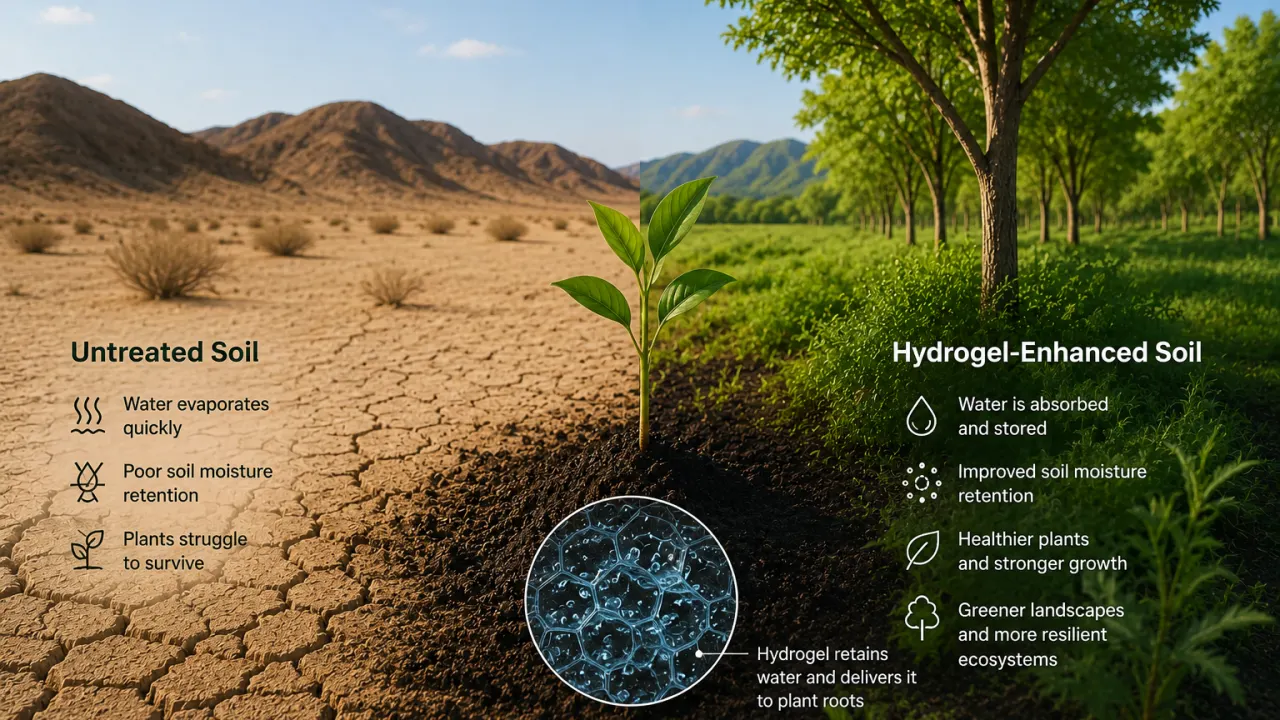
Deserts have one fundamental problem:
They cannot retain water.
In arid environments, rainfall evaporates quickly or drains beyond the reach of plant roots. Sandy soils often have extremely poor water retention, making long-term vegetation growth difficult without constant irrigation.
Researchers are now using hydrogels to change that.
Hydrogels are superabsorbent polymer networks capable of storing hundreds of times their weight in water and slowly releasing it over time. In medicine, they are used in wound dressings and drug delivery systems. In agriculture, they are emerging as a powerful tool for improving soil water retention in drought-prone regions.
Turning soil into a water reservoir
When mixed into soil, hydrogels absorb water during irrigation or rainfall and gradually release it back to plant roots as the surrounding soil dries.
Effectively, the soil gains a built-in water reservoir.
Multiple studies have demonstrated measurable agricultural benefits:
- Research in sandy soils showed hydrogel incorporation increased water retention by up to 400% compared to untreated soil.
- Studies in drought-stressed crops reported significant reductions in irrigation frequency while maintaining plant growth.
- Agricultural hydrogel systems have also demonstrated improvements in seedling survival, biomass accumulation, and nutrient retention in arid conditions.
In regions where irrigation water is limited, these improvements can dramatically impact plant survival and long-term soil productivity.
Real-world applications are already happening
Hydrogels are no longer just experimental lab materials.
They are already being explored and deployed in:
- Desert agriculture projects
- Reforestation initiatives
- Drought-resistant landscaping
- Water-efficient farming systems
In parts of the Middle East and India, superabsorbent hydrogels have been tested to reduce irrigation demand for crops grown in sandy soils.
Some forestry and land restoration programs are also evaluating hydrogel-assisted planting methods to improve early-stage tree survival in degraded environments where saplings would otherwise die from water stress.
Researchers are additionally combining hydrogels with:
- slow nutrient release systems
- biodegradable cellulose materials
- atmospheric water harvesting technologies
to create integrated platforms for climate-resilient agriculture.
Why this matters now
Climate change is accelerating desertification globally.
Regions across Africa, the Middle East, Central Asia, and the American Southwest are facing:
- declining groundwater reserves
- increasing drought frequency
- soil degradation
- lower agricultural productivity
Traditional irrigation alone is becoming increasingly unsustainable.
Hydrogels offer a different strategy: instead of continuously adding more water, they help retain and manage the water already available.
The bigger shift
What makes this especially interesting is that hydrogels are not fertilizers or pesticides.
They are changing the physical behavior of the soil itself.
They influence:
- water transport
- evaporation dynamics
- nutrient retention
- root-zone hydration
In other words, they allow us to engineer how landscapes interact with water.
For years, “greening deserts” sounded unrealistic.
Today, materials science is making it increasingly plausible.
And surprisingly, one of the most important climate technologies of the future may be a soft, water-filled polymer hidden beneath the soil.
First published on LinkedIn.