
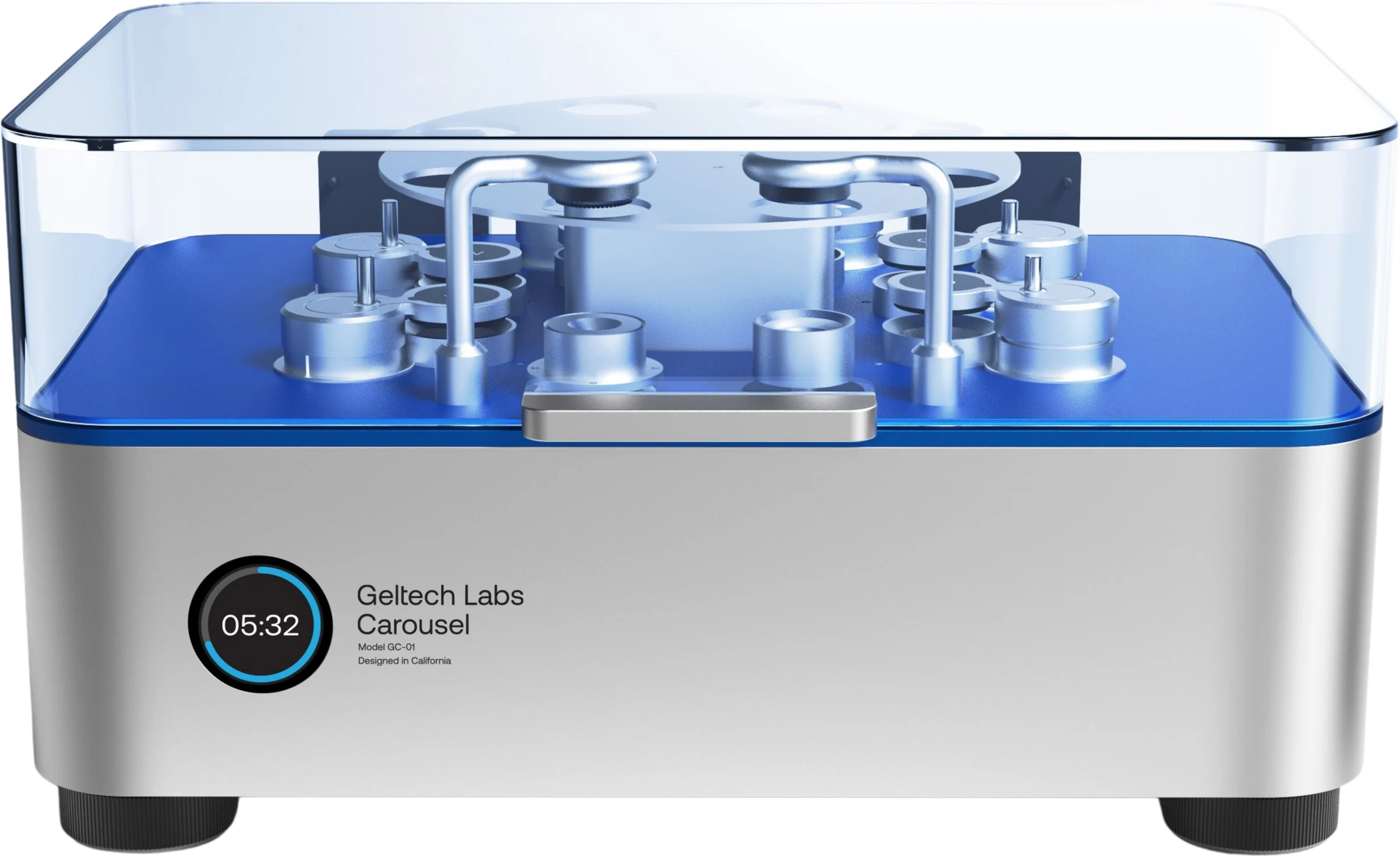
Carousel: Accelerating biomaterials R&D
Measure swelling, degradation, release and pH continuously on six samples at a time, around the clock, under controlled pH, temperature, strain and flow, for data closer to in vivo conditions.
21 CFR Part 11 compliant
ASTM/ISO-aligned methods
Compatible form factors
- Powders
- Films and sheets
- Tablets
- Injectables
- Microparticles
- Amorphous gels
- Foams
- Implants
In a single Carousel run:
-
Swelling and hydration
Mass at every timepoint, to 1 mg.
-
Degradation
Mass loss tracked for weeks to months.
-
Release
The medium is sampled automatically to UV-Vis, HPLC or LC-MS.
-
Computer vision
On-board cameras capture each sample frame by frame.
-
pH
Monitored in line, from 1.5 to 12.
-
Mechanical properties
Method suitable for synthetic polymers only.
Manual testing versus Carousel
Free your time for discovery, let Carousel do the lifting.
Mass across one week
Illustrative · one sample, mass as % of its peak ± SD
| Measure | Manual | Carousel | Result |
|---|---|---|---|
| Testing hours a week | 40 | 168 | 7x more data |
| Hands-on labor | 5 hours | 30 minutes | 10x lower cost |
| Measurement error | 10% | 3% | 3x lower variability |
-
7xMore data
24/7 testing
168 hours of testing a week instead of a 40-hour bench schedule.
-
10xLower cost
Fully automated
Labor and consumable costs per datapoint, up to 10x lower.
-
3xHigher precision
Filtration conditioning
Lower sample-to-sample variability than manual gravimetric methods.
Technical specifications
Check Carousel against your test plan with the full specifications.
| Measurement | |
|---|---|
| Maximum load | 100 g |
| Gravimetric resolution | 1 mg |
| Minimum sample mass (dry) | 25 mg |
| Chamber and fluidics | |
| Sample chamber volume | 24 mL |
| Incubation chamber volume | 50 mL, around the sample chamber |
| Mechanical pressure | 0.1 to 1 PSI |
| Filter pore sizes | 0.1 to 1,000 µm |
| Filter materials | Polypropylene, nylon, PTFE |
| Flow control | 5 to 150 mL/min |
| Environment | |
| Temperature control | Ambient to 60 °C |
| pH compatibility and monitoring | 1.5 to 12 |
| System | |
| Dimensions | 400 mm wide, 600 mm high, 400 mm deep |
| Sample form factors | Liquids, gels (semi-solids), solids |
| Modality | Online (cloud) or offline |
| Data output | .csv and .jpg |
Specifications are subject to change. Custom configurations are available on request.
Bring Carousel into your lab, or run with ours
-
Buy or lease
Carousel in your lab, with install, training, verification and validation (V&V) and a 30-day trial.
Configure a Carousel -
Run remotely
Send samples and run your study on our units, or have our lab run it for you.
See R&D services
Related guides
All guides-
Hydrogel characterization and swelling
Automated hydrogel swelling measurementHow to measure hydrogel swelling without lifting the sample by hand: where manual readings diverge, how drain-and-weigh, imaging, NMR and QCM-D methods work, and what each one misses.
-
Automation and data quality
Where manual swelling and degradation tests varyWhere manual gravimetric swelling and degradation readings vary, step by step: the blot, time in air, timing, transfers, drying to constant weight and the operator, with what each does to the number and how a manual lab can tighten it.
-
Hydrogel characterization and swelling
Hydrogel swelling ratio: formulas and a worked exampleHow to calculate a hydrogel's swelling ratio from wet and dry mass, how it relates to equilibrium water content and volumetric swelling, how to run the bench test, and where published definitions disagree.
-
Pilot study and buying
Outsource a study or buy an instrumentA decision framework for biomaterials teams choosing between outsourcing a study and buying the instrument: volume, study length, staff time, method validation, ownership costs, time to first data, and when a pilot should answer first.

Try Carousel on your material
Tell us what you're developing. We'll scope a trial, a lease or a study, and the first consultation is on us.