 GelTech Labs
Automated swelling and degradation testing of Viatel™ PLGA-PEG-PLGA and PDLLA-PEG2000
Summary
GelTech held three Viatel™ samples from Ashland in PBS at 37 °C on Carousel for 14 days, weighing each automatically from 5 minutes on: an mPEG-PDLLA diblock and two lots of one PLGA-PEG-PLGA triblock grade. The two lots separated by 41% at Day 9, 9.94 against 7.07 g/g. Lot A peaked at 10.15 g/g on Day 12 and lost 18% by Day 14, while Lot B measured 7.2 g/g at Day 14. The lots ran one day apart, so a side-by-side run would confirm the gap. The diblock, tested neat, lost 91% of its peak mass within 8 hours.
What it means for Ashland
One 14-day run gave Ashland a quantitative swelling and degradation profile for each sample, and a way to compare lots of one grade on the same measure. The same instrument can extend the work to full degradation, drug release, pH and flow.
Two lots of one grade in the Carousel chamber
41%apart at Day 9, two lots of one grade
Swelling ratio at Day 9 in PBS at 37 °C, n = 3. The lots ran one day apart, so a side-by-side run would confirm the gap.
- 41%swelling gap between two lots of one grade at Day 9
- 14 daysof automated readings, from 5 minutes on
- 91%of peak mass the diblock lost within 8 hours, tested neat
Results
Swelling ratio is wet mass divided by initial mass. A ratio above 1 means the sample took up water, and a falling ratio means it's losing mass.
Lot A and Lot B over 14 days, the diblock over 8 hours
Lot A and Lot B · 14 days
Diblock · first 8 hours
Materials and methods
Three Viatel samples ran in triplicate under one protocol: an amphiphilic diblock and two lots of a thermosensitive triblock. Every sample sat in a sealed PTFE mesh chamber in PBS at 37 °C, and Carousel drained and weighed each chamber on schedule, from 5 minutes through Day 14.
Diblock PDLLA-PEG2000 (mPEG-PDLLA)
An amphiphilic diblock that self-assembles into micelles in water, used to solubilize poorly soluble drugs. Tested neat in PBS, it peaked at 1.65 g/g at 5 minutes and fell to 0.15 g/g by 8 hours, so it's best tested formulated.
Lot A PLGA-PEG-PLGA triblock, thermosensitive
A triblock with a PEG core: liquid at room temperature, a gel at 37 °C, used for in situ forming injectable depots. Lot A swelled further, peaking at 10.15 g/g on Day 12, then lost 18% by Day 14 as it began to degrade.
Lot B PLGA-PEG-PLGA triblock, a second lot
The same triblock grade, from a second lot. Lot B swelled faster early, 3.2 g/g at 8 hours against Lot A's 2.4, then less far: 7.07 g/g at Day 9 and 7.2 g/g at Day 14.
Swelling and degradation · 14 daysStatic immersion, gravimetric
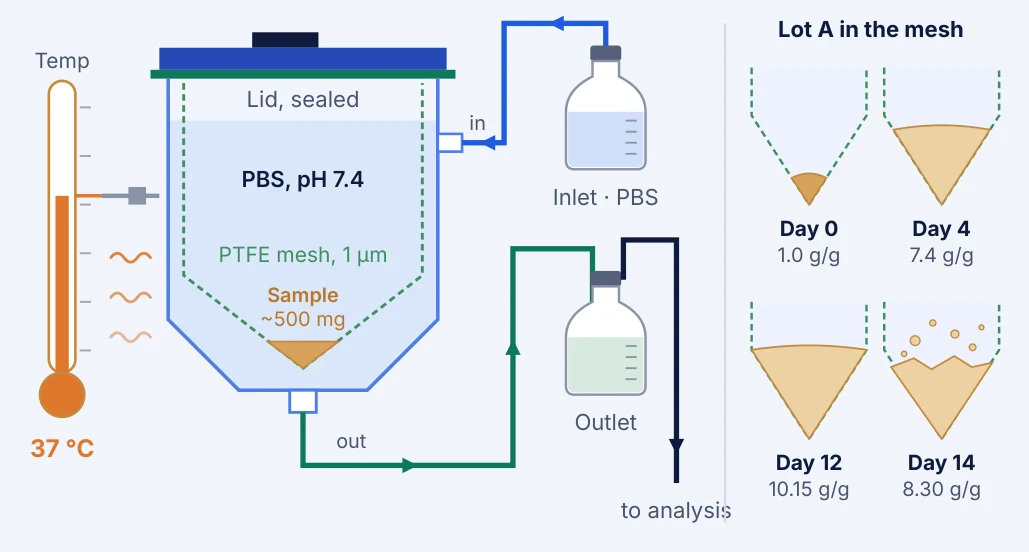
Setup. About 500 mg of sample sits in a sealed, conical PTFE mesh chamber in 100 mL of PBS, pH 7.4, static at 37 °C. Carousel drains and weighs the chamber at every timepoint.
Readout. Swelling ratio, wet mass ÷ initial mass, at 5, 10 and 30 min, 1, 2, 4 and 8 h, then daily to Day 14.
Static immersion, gravimetric. Flow-through and circulating modes use the same chamber.
First 8 hours · all threeStatic immersion, gravimetric
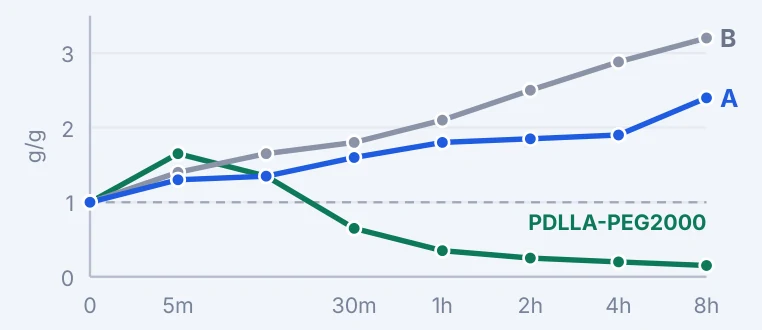
Mean, n = 3 (n = 2 for PDLLA-PEG2000) · Lot B swells faster early, 3.2 against 2.4 g/g at 8 h
Static immersion, gravimetric. PBS, pH 7.4, 37 °C
Lot A · peak to Day 14Static immersion, gravimetric
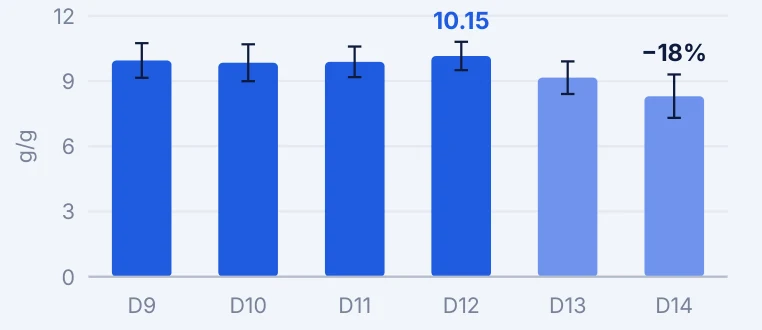
Mean ± SD, n = 3 · plateau near 10 g/g from Day 9, peak at Day 12, then 18% mass loss by Day 14
Static immersion, gravimetric. PBS, pH 7.4, 37 °C
Results summary
| Measure | Diblock | Lot A | Lot B |
|---|---|---|---|
| Peak swelling (g/g) | 1.65 at 5 min | 10.15 at Day 12 | 7.2 at Day 14 |
| Swelling at 8 h (g/g) | 0.15 | 2.4 | 3.2 |
| Swelling at Day 9 (g/g) | degraded | 9.94 | 7.07 |
| Change from peak | −91% by 8 h | −18% by Day 14 | plateau |
Methods. About 500 mg per chamber (0.47 to 0.58 g) in a conical PTFE mesh chamber with a 1 µm hydrophilic membrane, in 100 mL PBS, pH 7.4, lid closed, static at 37 °C. PLGA-PEG-PLGA was thawed from −20 °C before loading. Dry tare, then wet tare after a 3 min PBS pre-wet. Chambers were drained and weighed at 5, 10 and 30 min, 1, 2, 4 and 8 h, then daily to Day 14. Lot B Days 10 to 13 were excluded for a drainage deviation; the chart shows values interpolated between Days 9 and 14. The two lots ran one day apart, and a side-by-side run would confirm the gap. One PDLLA-PEG2000 chamber was excluded below tare. Mean values. Bench data. Viatel™ polymers supplied by Ashland.
GelTech Labs
Sinan Gölhan, CEO · sinan@geltechlabs.com