Hydrogel characterization for drug delivery


The core readouts in hydrogel characterization for drug delivery are swelling, mesh size, rheology, degradation, drug loading and release, and chemistry. They connect through the network’s mesh, which Li and Mooney put at 5 to 100 nm in typical hydrogels. Swelling and stiffness estimate the mesh, the mesh against the drug’s size sets diffusion, and degradation opens the mesh over time.
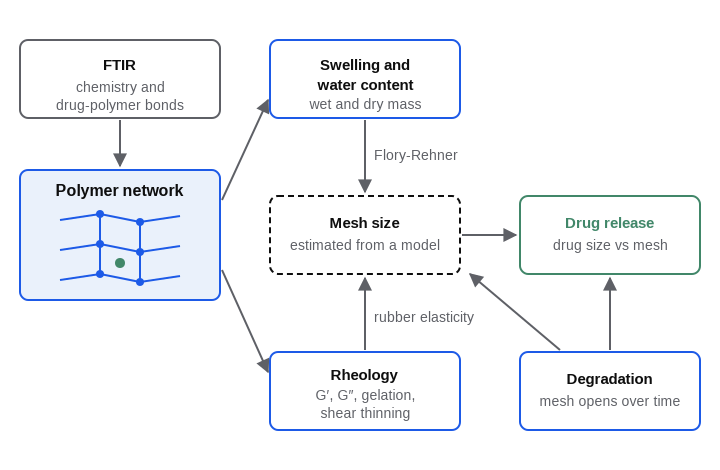
Illustrative schematic. Two separate routes estimate mesh size: Flory-Rehner theory from swelling, and rubber elasticity from the storage modulus. Release depends on the drug’s size against the mesh.
What does each readout in hydrogel characterization answer?
Each readout answers one question about the network and misses something another readout catches. The table matches them up.
| Question | Readout | Instrument | What it misses |
|---|---|---|---|
| How much fluid does the network hold? | Swelling ratio, equilibrium water content | Balance, at timepoints until the mass stops changing | Why it holds that much, and anything after equilibrium |
| How open is the network? | Mesh size | Calculated from swelling or from the storage modulus; SAXS or SANS for a direct read | A calculated value is a model estimate, and the two routes can disagree |
| Does it gel, and can it be injected? | G′, G″, gelation time, viscosity against shear rate, recovery, injection force | Rheometer; force sensor on the syringe | Behavior in the tissue, and what happens after days in fluid |
| How much drug did the gel take up? | Loading, encapsulation efficiency | UV-Vis or HPLC on the drug left outside the gel | Where in the network the drug sits |
| How fast does the network break down? | Wet mass, dry mass, gel fraction over time | Balance, plus freeze-drying for dry mass | Which bonds break, and whether drug leaves first |
| How fast does the drug leave? | Cumulative % released, against the loading above | UV-Vis, HPLC or LC-MS on sampled medium | What the gel was doing while the drug left |
| What’s bonded to what? | Band positions and shifts | FTIR | Crosslink density, mesh size and how much drug is loaded |
How do swelling and water content describe the network?
Swelling tells you how much fluid the network holds against its own elasticity, and it moves with the medium as much as with the gel. Yang, Dargaville and Hutmacher saw every PEG-diacrylate formulation they tested swell less in PBS than in water, so a gel swollen in water and the same gel in buffer give two different numbers.
The formulas, the wet and dry mass calculation and a worked example sit on the hydrogel swelling ratio page. For a drug-delivery gel, the equilibrium swelling ratio feeds the mesh size estimate below, and the curve on the way there shows how fast the network opens. To take that curve without lifting each sample by hand, see automated hydrogel swelling measurement.
How is hydrogel mesh size estimated?
Mesh size is estimated from swelling or stiffness, or measured more directly by scattering. Li and Mooney list rheology, swelling, indentation, compression and tensile tests as indirect routes, and name electron microscopy, atomic force microscopy, SAXS and SANS among the direct ones. Confocal microscopy, they note, can’t resolve below about 1 µm, far coarser than a typical mesh. The two calculated routes are the ones a formulation lab can run on a balance and a rheometer.
- From swelling (Flory-Rehner): the equilibrium polymer volume fraction goes into an equation that balances the free energy of mixing against the network’s elasticity, giving the molecular weight between crosslinks. A Canal-Peppas relation then turns that into a mesh size. Richbourg, Peppas and colleagues use this route with corrections for junction functionality and chain-end defects.
- From stiffness (rubber elasticity): in Li and Mooney’s simplified form, mesh size scales with the inverse cube root of the shear modulus. By our arithmetic, doubling G′ shrinks that estimate by about a fifth, since 2 to the power of −1/3 is 0.79. Fuller rubber-elasticity models, such as the one Richbourg and colleagues use, also take the polymer volume fractions from swelling.
Both routes are models. Richbourg and colleagues report that the standard mixing-and-elasticity balance “does not match experimental data from simple real swollen network systems”, though their own swelling-based and synthesis-based predictions of mesh size agreed closely for PVA and PEG-diacrylate gels. The swelling route also needs a polymer-solvent interaction parameter and densities. The stiffness route needs a modulus measured inside the linear range, plus swelling data in the fuller models. Report which route you used, with its inputs.
Which rheology tests does a drug-delivery hydrogel need?
A drug-delivery hydrogel needs tests for gelation, stiffness, shear thinning and recovery. Together they show whether the material gels, how stiff it gets, and whether it can be pushed through a needle and set again. The storage modulus G′ reads the energy the gel stores, and the loss modulus G″ the energy it dissipates.
Gelation time needs care. Sun Han Chang and colleagues note that the time at which G′ crosses G″ “can strongly depend on the imposed frequency” and differs from the gel point found by the Winter-Chambon method, where the moduli follow the same power law across frequencies. The crossover works for comparing formulations measured at the same frequency, and it moves when the frequency does.
For an injectable, Chen, Burdick and colleagues set out a sequence: frequency and strain sweeps to find the linear range and the yield strain, a shear-rate ramp for shear thinning, cycles of high and low strain for recovery, and injection force through the intended needle. They measured force with a sensor behind the syringe. In their 5 wt% guest-host hyaluronic acid gel, force at 2 mL/h went from 0.4 N through an 18G needle to 7 N through a 27G needle, and from 4 N to 13 N as a 25G needle grew from ¼ to 1½ inches. They put clinically relevant injection force typically under 20 N. Reading the modulus beside swelling is the subject of hydrogel rheology and swelling, and the injection step of injectable hydrogels for drug delivery.
How does mesh size connect to drug release?
Mesh size against the drug’s size decides whether the network slows diffusion at all. Li and Mooney describe three cases:
- Mesh much larger than the drug: small molecules move freely, and diffusion is largely independent of mesh size.
- Mesh close to the drug’s size: steric hindrance slows diffusion and extends release.
- Mesh smaller than the drug: the drug is held until the network degrades or swells open.
Diffusion time scales with the square of the gel’s thickness, and Li and Mooney estimate that protein diffuses out of a 1 mm gel in about 0.3 to 30 hours. They conclude that diffusion-dominated release “cannot achieve extended release beyond hours to a day”. A small molecule in a 5 to 100 nm mesh falls in the first case, so weeks of release from a gel that size need something else to hold it back, such as binding to the network or a mesh that only opens as the gel degrades. Release itself is read in sampled medium by UV-Vis, HPLC or LC-MS, with method choice and sink conditions covered in in vitro release testing for long-acting injectables.
What does degradation add?
Degradation changes every other readout, because the mesh opens as the network breaks down. Li and Mooney state that mesh size increases as the network degrades, which lets trapped drug diffuse out. So a swelling ratio, a modulus and a mesh size each describe the gel at one moment.
A degrading hydrogel can also take up more water while it loses polymer, so wet mass and dry mass can move in opposite directions. The polymer degradation testing guide sets out which mass to weigh and when, and hydrolytic versus enzymatic degradation helps you choose the medium.
Which hydrogel properties can FTIR detect?
FTIR detects which chemical groups are present and whether their bands shift when drug or crosslinker is added. In Hebip and colleagues’ calcium-alginate beads, the carboxylate band shifted to about 1416 cm⁻¹ with amoxicillin and about 1412 cm⁻¹ with doxycycline, which the authors tie to where each drug sits in the calcium-crosslinked network. They read new bands near 1604 and 1596 cm⁻¹ as the drugs interacting with alginate’s carboxylate groups.
The comparison sets the limit. Their reference was sodium alginate powder, at 1410 cm⁻¹, with no drug-free calcium alginate bead, so the shift can’t be split between calcium crosslinking and the drug. Run a blank gel through the same process. The same paper measured neither crosslink density nor mesh size. FTIR confirms a chemistry, and sizing the network or counting the drug takes the other readouts in the table.
How should you choose readouts for a formulation screen?
Start with the decision, then pick the cheapest readouts that bear on it. These pairings are starting points rather than a published rule.
- Ranking many candidates: swelling curves and release, on the same conditions, with rheology on the leads.
- An injectable: rheology first, since a gel that won’t pass the needle never reaches a release test.
- Release that runs long or stalls: degradation and release on one timeline, with mesh size estimated at more than one timepoint.
- A new chemistry: FTIR to confirm the bonds, then swelling and rheology.
Comparing hydrogel formulations covers holding conditions constant so a ranking means something, and what to put in a study brief covers scoping the readouts before a study starts.
What a GelTech study measures on hydrogel characterization
A GelTech hydrogel study returns swelling and degradation as curves. Carousel holds each gel in a 24 mL sample chamber inside a 50 mL incubation chamber, drains free fluid, and weighs it at every timepoint to 1 mg, six samples at a time. Its mass data carries roughly 3x less data variability than manual work. Stiffness (G′, G″ and compressive modulus) comes from separate samples at set timepoints, measured on integrated instruments and read beside the mass curve.
GelTech’s integrated instruments cover what a balance can’t: rheometry for G′, G″ and frequency sweeps, UV-Vis, HPLC and LC-MS for loading and release, and FTIR for chemistry. Runs use the temperature you set, in media from pH 1.5 to 12, for data closer to in vivo conditions and a stronger basis for IVIVC, though the gel’s behavior in tissue still needs animal studies.
GelTech doesn’t run animal or clinical studies, or accredited biocompatibility or sterility testing. See drug delivery, R&D services and how a pilot study works.
Sources
- Li J, Mooney DJ. Designing hydrogels for controlled drug delivery. Nat Rev Mater. 2016;1:16071
- Richbourg NR, Wancura M, Gilchrist AE, et al. (Peppas NA, senior author). Precise control of synthetic hydrogel network structure via linear, independent synthesis-swelling relationships. Sci Adv. 2021;7(7):eabe3245
- Yang X, Dargaville BL, Hutmacher DW. Elucidating the molecular mechanisms for the interaction of water with polyethylene glycol-based hydrogels: influence of ionic strength and gel network structure. Polymers. 2021;13(6):845
- Sun Han Chang R, Lee JCW, Pedron S, et al. Rheological analysis of the gelation kinetics of an enzyme crosslinked PEG hydrogel. Biomacromolecules. 2019;20(6):2198-2206
- Chen MH, Wang LL, Chung JJ, et al. Methods to assess shear-thinning hydrogels for application as injectable biomaterials. ACS Biomater Sci Eng. 2017;3(12):3146-3160
- Hebip İ, Toprakçı İ, Bozkurt RN, et al. Structure-property relationships governing encapsulation and release of antibiotics from calcium-alginate hydrogels. Gels. 2026;12(7):636
Related reading
GelTech services and industries
Questions
Which hydrogel readout should a drug-delivery study start with?
A drug-delivery hydrogel study usually starts with swelling and release together, since a wet mass curve leaves each sample in the run and changes with the network, and release is the result the program needs. The equilibrium ratio and any mesh size estimate still need a dry mass, which ends that sample.
How well do swelling-based mesh size estimates hold up?
Swelling-based mesh size estimates held up well for synthetic PVA and PEG-diacrylate gels in Richbourg, Peppas and colleagues' study, where predictions from synthesis and from swelling were highly consistent. Their gelatin methacrylamide gels didn't follow the same relationships, though fewer and smaller samples confounded that analysis, so treat a gelatin-based estimate with care.
Why do two labs report different mesh sizes for the same hydrogel?
Two labs can report different mesh sizes for one hydrogel because each estimate depends on its model, its inputs and the gel's state when measured. A swelling estimate needs a polymer-solvent interaction parameter and densities, a modulus estimate needs a frequency and strain inside the linear range, plus swelling data in the fuller models, and both shift with the medium and the time the gel has spent in it.