Wound dressing fluid handling and EN 13726


Wound dressing fluid handling is what a dressing does with exudate: takes it up, holds it under pressure, and lets it out as vapor. EN 13726:2023 sets the test methods in lettered annexes, eight of them normative test methods, and sets no absorbency figure a dressing has to reach. Its free swell test reads one value, after a 30-minute soak, on a dressing saturated in test fluid.
What is wound dressing fluid handling?
Fluid handling is the balance between three routes: fluid absorbed into the dressing, fluid held there when something presses on it, and water vapor leaving through the backing. EN 13726:2023 defines fluid handling capacity as the sum of fluid absorbed and moisture vapor loss, in grams per square centimeter of absorbent area.
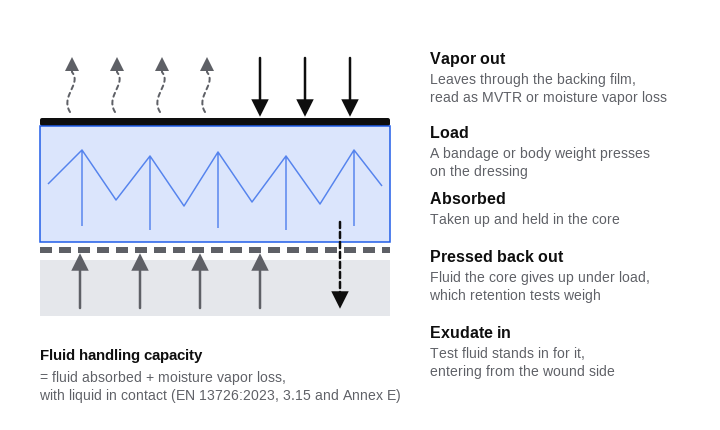
Illustrative schematic. Where fluid goes in a dressing, with no measured values.
The balance matters because healing sits in a moisture window. A wound that’s too dry stalls, and one that’s too wet macerates. Work on moist healing goes back to Winter’s 1962 study in Nature of scab formation and the rate of epithelization in superficial wounds in young pigs.
Which tests are in EN 13726:2023?
EN 13726:2023 covers absorption, moisture vapor transmission, waterproofness and extensibility of wound dressings. Its foreword says it supersedes EN 13726-1:2002, -2:2002, -3:2003 and -4:2003, from CEN technical committee 205. Annex A, items 1 and 2, explains the merger: the four parts overlapped, so each test is now its own annex, and “primary” left the title because the tests apply to secondary dressings such as films too.
| Property | What it measures | EN 13726:2023 annex |
|---|---|---|
| Free swell absorptive capacity | Fluid taken up in excess test fluid with no load | B, normative |
| Fluid retention capacity | Absorbed fluid kept after a load is applied | C, informative |
| Absorption under compression | Fluid taken up while the dressing is already under pressure | D, informative |
| Fluid handling capacity | Fluid absorbed plus moisture vapor loss, with liquid in contact | E, normative |
| Fluid donation | How much fluid an amorphous hydrogel gives to a simulated wound | F, normative |
| Dispersion characteristics | Whether a gelling dressing holds together or disperses | G, normative |
| MVTR, vapor in contact | Moisture vapor passing through a film, with only vapor on the wound side | H, normative |
| MVTR, liquid in contact | Moisture vapor passing through a film, with liquid on the wound side | I, normative |
| Waterproofness | Whether the dressing withstands a 500 mm hydrostatic head | J, normative |
| Extensibility and permanent set | Force to stretch the dressing, and the length it keeps after relaxing | K, normative |
Three further informative annexes support the test methods: a gasket for the test cylinder (N), air expulsion before fluid handling testing (O) and dressing sizes for pressure calculations (P).
Conformability, the ability to adapt to the shape and movement of the body, keeps a definition in the standard. Its test is extensibility and permanent set under tension. Ghezzi and Graziani note that the test runs on dry, conditioned samples, and that while this improves reproducibility, dressings in use are often wet.
The standard’s Table 1 matches annexes to dressing classes. Clause 5 calls it a guide to test selection rather than a complete list:
- Foam, and single or multi-layer absorbent dressings: B, C, D, E, J and K.
- Super-absorbent dressings: B, C, D, E and J.
- Gelling fiber dressings: B, C, D and G.
- Hydrocolloid sheets: E, J and K.
- Film dressings: H, I, J and K.
- Amorphous hydrogels: F.
Fluid handling capacity needs a liquid-impermeable backing film, which is why a gelling fiber dressing doesn’t take Annex E. The scope limits the MVTR methods to permeable film wound and fixation dressings, and MVTR for wound dressings covers them.
Which test fluid and temperature does EN 13726 use?
EN 13726 uses Solution A, a sodium chloride and calcium chloride solution, across every absorption and MVTR annex. Svensby and colleagues give its composition as 142 mmol/L sodium ions and 2.5 mmol/L calcium ions, as the chlorides. Hasatsri and colleagues, following the 2002 part, made it from 8.298 g sodium chloride and 0.367 g calcium chloride dihydrate in a liter of deionized water.
Published method papers give the temperature, since the annexes that set it aren’t public. Hasatsri ran free swell at 37 °C. A 2025 review by Nygren, Malone and Gefen, two employees of and a paid consultant to the dressing maker Mölnlycke Health Care, describes Svensby’s fluid handling run, “with minor deviations” from the standard, as 24 hours at 37 °C on a Paddington cup.
Annex L, as the review describes it, lets a lab use another fluid that simulates exudate, and Annex A item 13 asks that it be noted as a deviation with its reason. “In cases of dispute the reference Test Solution A shall be used.” The choice moves results:
- Protein: for four of eight foam dressings, Svensby found Solution A overstated 24-hour fluid handling capacity by 17% to 155% against two protein-containing fluids. The error differed from dressing to dressing.
- Wetting: Solution A had higher surface tension and contact angle than the protein fluids, and a pH of 5.6 against 7.5 to 7.7.
- Who ran it: Svensby’s team is Mölnlycke’s R&D group, with Gefen and Breda Cullen as paid consultants, and it developed one of the alternative fluids. The authors say that fluid still needs validation across operators, labs and dressing types.
A revision, prEN 13726 rev, is listed as in development at CEN/TC 205. Its notes say the work item is validating an alternative fluid for the fluid handling methods, with multi-lab testing under way, and may add odor control, conformability and adhesiveness methods.
What does EN 13726 require of a dressing?
EN 13726 requires methods rather than results. Clause 4 sets two outcomes: a gelling dressing is classed as dispersing or non-dispersing under Annex G, and a waterproof dressing shows no fluid penetration under Annex J. A dressing claiming Annexes B, E, F, H, I or K has to be tested by that annex. There’s no absorbency or MVTR number to pass, so the limits come from the product specification.
Three more lines from the same clauses shape how a result reads:
- Optional tests: Annexes C and D are “optional additional tests”. Annex A says they’re “informative at present as inter-laboratory experiments have shown unexplained variation, especially between laboratories.”
- Deviations: any deviation from a test parameter “shall be validated by the laboratory undertaking the test” and noted in the report.
- Caution: the methods are in vitro, and results “should always be evaluated with caution” against intended use.
Why does a single endpoint hide the uptake curve?
A single reading gives capacity at one time and says nothing about how fast the dressing got there or whether it held. Annexes B and D incubate for 30 minutes, which Annex A item 5 traces to earlier UK work, and Annex E runs 24 hours, with longer runs optional. Annex A also says the absorption tests “are based on fully saturated dressings which is rarely the clinical situation”, since most dressings leak or are changed before saturation.
Hasatsri and colleagues followed free swell for 12 hours on 2 × 2 cm cut squares of six dressings, weighed by hand in triplicate, using the 2002 method “with slight modifications”. Cut samples can read low for some dressings, so their capacities don’t stand in for intact ones. The time course still showed what one reading misses:
- Rate and peak: the calcium sodium alginate had the highest absorption of the six, then degraded after about 4 hours.
- Breakdown: the calcium alginate degraded after about an hour.
- Slow uptake: both hydrocolloids absorbed little and slowly.
A 30-minute reading would score the alginates on capacity and miss the breakdown. Nygren and Gefen, a Mölnlycke employee and a paid Mölnlycke consultant, add that free swell ignores the one-way flow of exudate from the wound into the dressing. They also grant that fluid handling capacity “allows for reproducible results, which is important for quality control across batches.” Compression changes the picture again, which free swell versus absorption under load covers. For the swelling arithmetic behind each reading, see the hydrogel swelling ratio.
What does a fluid handling claim need behind it?
A fluid handling claim needs each number tied to its method, sample and time. The definitions in EN 13726:2023 set the units: free swell is grams per dressing and per square centimeter for an intact dressing, per square centimeter for a sectioned sheet, and grams per gram for a rope or ribbon. A claim that holds up names:
- Edition and annex: 2023 annex letters replace the 2002 and 2003 part numbers, so name which one the number came from.
- Status: normative or informative, so a reader weighs a C or D result accordingly.
- Sample form: intact or cut, and the absorbent area used.
- Fluid: Solution A, or the alternative and why.
- Time course: the endpoint the annex asks for, plus the curve to it.
- Spread: replicates and their variation within the lab. That doesn’t answer between-lab variation, and Nygren and Gefen found operator-to-operator differences in fluid handling results when Annex O was applied, so name who ran the test and how.
A buyer comparing claims needs the same fields. Nygren and Gefen warn against reading higher fluid handling capacity as better without clinical context.
What a GelTech study measures on wound dressing fluid handling
A GelTech dressing study follows free swell, absorption and MVTR as a curve, on a test menu aligned with EN 13726. Carousel runs absorption under load at 0.3 to 0.7 psi and weighs each sample to 1 mg at every reading, six samples at a time, with roughly 3x less data variability in its mass data than manual work. Integrated instruments such as rheometry and FTIR cover the mechanics and chemistry a mass curve can’t. A curve departs from a single-endpoint annex, and clause 5 asks that any deviation be validated and noted, so agree up front which reading stands as the annex result.
You get a documented dataset and report for your quality team. Your specification sets the limits. GelTech doesn’t run clinical or animal studies, sterility or biocompatibility testing, or make the regulatory decision. See wound dressing testing, how a pilot study works and what to put in a study brief.
Sources
- CEN. EN 13726:2023 Test methods for wound dressings: aspects of absorption, moisture vapour transmission, waterproofness and extensibility. Foreword, scope, definitions, clauses 4 and 5 and Annex A, in the SIST EN 13726:2024 preview
- Genorma. prEN 13726 rev, Test methods for wound dressings, CEN/TC 205 project listing
- Svensby AU, Nygren E, Gefen A, et al. The importance of the simulated wound fluid composition and properties in the determination of the fluid handling performance of wound dressings. Int Wound J. 2024;21(5):e14861
- Nygren E, Malone M, Gefen A. Laboratory evaluations of wound dressings: key advances to reflect clinical reality. Int Wound J. 2025;22(S1):e70333
- Nygren E, Gefen A. Little news is good news? What is missing in the recently published EN 13726:2023 test standard for wound dressings. Int Wound J. 2024;21(3):e14787
- Hasatsri S, Pitiratanaworanat A, Swangwit S, Boochakul C, Tragoonsupachai C. Comparison of the morphological and physical properties of different absorbent wound dressings. Dermatol Res Pract. 2018;2018:9367034
- Ghezzi D, Graziani G. New facile testing protocols to assess conformability of advanced dressings for wound healing. Int J Mol Sci. 2026;27(18):8149
- Winter GD. Formation of the scab and the rate of epithelization of superficial wounds in the skin of the young domestic pig. Nature. 1962;193:293-294
Related reading
GelTech services and industries
Questions
Does EN 13726 cover bacterial barrier or odor control?
EN 13726:2023 has no bacterial barrier or odor control test among its annexes. An odor control method was published separately as EN 13726-6 and has since been withdrawn. A revision now in development may add odor control, conformability and adhesiveness methods.
Which EN 13726 tests suit a gelling fiber dressing?
A gelling fiber dressing is listed in the standard's indicative guide against free swell (Annex B), fluid retention (Annex C), absorption under compression (Annex D) and dispersion characteristics (Annex G). Fluid handling capacity (Annex E) needs a liquid-impermeable backing film, so a fiber dressing without one isn't tested to it.
Can a lab cut a dressing before an EN 13726 test?
Cutting a dressing where necessary is allowed under EN 13726:2023, while other modification or mechanical treatment before testing isn't. The 2023 free swell test was changed to allow intact dressings, because sectioning a super-absorbent dressing can leach polymer out and lower the result.