What to automate first in soft biomaterials testing


Automate the step a person repeats most often over the longest run. For soft biomaterials, that’s usually the lift, blot and weigh cycle at every timepoint of a swelling or degradation study. By our arithmetic, six samples read at ten timepoints is 60 handling events, and each one can change the reading it’s meant to take.
Why are soft biomaterials hard to automate?
Soft biomaterials are wet, deformable and change while you test them, and lab automation handles liquids more easily than solids. A 2024 review of self-driving laboratories notes that, “in contrast to liquid dispensing, dispensing powders or other types of solids presents a more significant challenge”, and that automated labs often work around it with stock solutions. A formed gel can’t go into a stock solution and still be the sample.
Plates are one route around the handling. Xu, Hoare and colleagues had a robot mix injectable hydrogels in 96-well plates and read swelling, mechanics, degradation and protein release on the plate, with results consistent with bulk methods (abstract read). That suits screening many compositions. A mass curve on a formed sample of set size still means handling the sample, and four properties make that the hard part:
- Wet: surface fluid clings to the sample, and it has to come off the same way at every reading.
- Deformable: a gel tears under tweezers and smears under a pipette tip.
- Changing: it gains mass and size as it swells, then loses both as it degrades, so a gripper or a holder sized for day one may not fit day 30.
- Handled at every timepoint: a gravimetric study reads the same sample over and over, so every reading means taking it out of its medium and putting it back.
A drug in solution is sampled. A gel being weighed has to be handled.
Which step should a lab automate first?
Automate the step that scores highest on five criteria: how often it repeats, how long the study runs, hands-on time per timepoint, how much it varies between people, and how much its data is worth. Holland and Davies, citing Hayward and colleagues (2017), point to tasks “that require a high degree of repetition” as “likely to be precisely the type of tasks where automation can be effectively applied”. They also value letting an operator “walk away to think and focus on other tasks”, even when an automated protocol takes as long from start to finish.
| Criterion | Question to ask | Scores high when | Scores low when |
|---|---|---|---|
| Frequency | How many times per study does a person do this step? | Every timepoint, on every sample | Once, at setup or at the end |
| Duration | How long does the study run? | Weeks to months, with readings overnight and at weekends | Hours, inside one working day |
| Hands-on time per timepoint | How many minutes does each repeat take? | Lift, blot, weigh, return, refill, record | A single button press |
| Variability | Would two trained people get the same reading? | The blot, the timing and the transfers decide the number | The instrument decides the number |
| Data value | What decision rests on this measurement? | Ranking candidates, or a go or no-go on a formulation | A check nobody acts on |
Two checks come before the score. Holland and Davies call cost “the most significant hurdle”, and note that “a high level of experimental process variation” is more likely to need a bespoke system. A protocol that changes every project, or a cost the lab’s volume can’t carry, argues for keeping a step manual.
Score each remaining step one to three on each criterion and add them up. In an illustrative scoring of our own for a 12-week swelling study read at ten timepoints, the gravimetric reading scores 3, 3, 2, 3 and 3, for 14 of 15. Casting the gel scores 1, 1, 3, 2 and 2, for 9, since it happens once however long it takes. Release sampling comes close to the reading, since it also repeats at every timepoint.
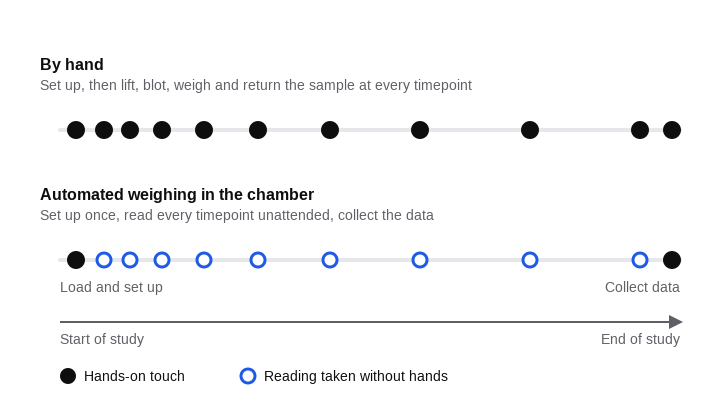
Illustrative schematic. Hands-on touches for the mass readings across one swelling or degradation study. Release samples and readouts on other instruments still need hands in both cases.
Where does manual handling add variability?
Manual handling adds variability at the steps between the bath and the balance. The 1997 edition of the contact lens water content standard ISO 10339, since withdrawn, named blotting as the main limit on its accuracy. The blot is one of six steps where a hand reading can drift, along with time out of the medium, timing, transfers, drying and the operator. Where manual swelling and degradation tests vary takes each one in turn.
Automation repeats the same handling at every timepoint, and brings its own risks. Holland and Davies note it “can replace many, but not all” human sources of variability. They also warn of the “rapid propagation of errors” in automated tasks, and that machine-to-machine variability “can be more hidden” than in manual procedures.
What can’t automation fix?
Automation can’t fix the choice of assay or the design of the study. It repeats a method exactly, including a poorly chosen one, so a wrong medium or a missing control comes out the same way every time.
- Assay choice: wet mass shows uptake and loss, and it can’t show molecular weight, release or modulus. Each needs its own measurement.
- Medium and conditions: the buffer, pH, temperature and enzyme set what the material does. Picking them is a scientific decision.
- Timepoints: a schedule that misses the steep early part of a swelling curve misses it whether a person or a machine reads it.
- Replicates and controls: automation can run more samples, and someone still has to decide how many and against what.
- Sample preparation: a gel cast unevenly varies before any test begins.
Holland and Davies put the choice with the people closest to the work: “Hands-on researchers are best placed to determine which elements of their protocols would benefit from automation.”
How do you evaluate an automation option?
Test it on your own material against your own manual method, and check it against the list below before you commit. Holland and Davies warn that commercial equipment often has “fixed componentry and locked-in software”, and that any system needs “careful maintenance, calibration and quality control”.
| Check | What to ask | Why it matters |
|---|---|---|
| Sample form and mass | Does it take your format (gel, film, powder, microparticles) at the mass you test? | A sample below the minimum load gives noisy readings |
| Conditions | Can you set your temperature, pH and medium, including enzymes, and keep them for the whole run? | Conditions you can’t set are conditions you can’t test |
| Surface fluid | How does it remove surface fluid before each reading, and is that the same every time? | In a manual reading, the blot is the step a contact lens standard named as its main limit on accuracy |
| Handling between readings | Does the sample stay in its medium, and is the chamber sealed against evaporation? | Every lift and every minute in air can move the number |
| Run length | How long can it run unattended, through nights and weekends? | Long studies are where the hands-on time adds up |
| Data | Does it give raw readings with timestamps, in a format you can open, plus images? | You’ll want the raw curve as well as the summary |
| Other instruments | Which readouts still need another instrument, and how do samples get there? | Release, molecular weight and mechanics rarely come from the same device |
| Side-by-side test | Has it run your material next to your manual method? | Check whether the means agree, since fluid-removal methods can differ, and see how the spread compares |
| Ownership | Buy, lease, send samples out, or keep it manual? | A study you run rarely may not repay an instrument |
The means check matters because fluid removal changes the number. Zhang, Feng and Jin found the tea-bag method confines a swelling powder, “leading to the measured swelling capacity significantly lower than their actual capacity”. Outsource a study or buy an instrument weighs the ownership row. Automated hydrogel swelling measurement covers how an automated swelling run works, combining mass, rheology, UV-Vis, MS and FTIR covers the other instruments, and what makes a biomaterials dataset useful covers the data.
Where do self-driving labs fit?
Self-driving labs add computer planning to experiments, and most are partly autonomous today. The 2024 review notes that “Level 2 and 3 SDLs make up the vast majority of SDL examples to date”. Its Level 2 includes manual experiments guided by several rounds of computer-proposed experiments. For robotically simple tasks, it reports, “a series of Level 4 SDLs have been demonstrated”, while “a true Level 5 SDL remains an unattained goal in the field”.
For polymers, a NIST-led perspective in Macromolecules lists a lack of shared standards for hardware, software and data among the barriers to automated characterization. Self-driving labs for biomaterials covers the planning side.
What a GelTech study measures on automation
GelTech runs the repeated reading on Carousel, its own instrument, six samples at a time. Each sample sits in a 24 mL sample chamber inside a 50 mL incubation chamber, behind a filter chosen from 0.1 to 1,000 µm. Carousel tracks drained wet mass, weighed to 1 mg at every timepoint, from ambient to 60 °C in media from pH 1.5 to 12. Setup takes minutes of hands-on time rather than hours, and Carousel’s mass data carries roughly 3x less data variability than manual work. Release, rheology and chemistry come from integrated instruments such as UV-Vis, HPLC, LC-MS, FTIR and rheometry.
For a test Carousel doesn’t run, GelTech’s custom automation design service automates a manual test method. The platform overview shows how the lab, Carousel and AnGel AI, now in beta, fit together. GelTech doesn’t run animal or clinical studies, or accredited biocompatibility or sterility testing. See how a pilot study works.
Sources
- Holland I, Davies JA. Automation in the life science research laboratory. Front Bioeng Biotechnol. 2020;8:571777
- Tom G, Schmid SP, Baird SG, et al. (Aspuru-Guzik A, senior author). Self-driving laboratories for chemistry and materials science. Chem Rev. 2024;124(16):9633-9732
- Xu F, Corbett B, Bell S, et al. (Hoare T, senior author). High-throughput synthesis, analysis, and optimization of injectable hydrogels for protein delivery. Biomacromolecules. 2020;21(1):214-229 (abstract)
- Beaucage P, Sutherland D, Martin T (NIST). Automation and machine learning for accelerated polymer characterization and development: past, potential, and a path forward. Macromolecules. 2024;57(18) (abstract)
- ISO 10339:1997 (withdrawn 2006, replaced by ISO 18369-4). Ophthalmic optics, contact lenses, determination of water content of hydrogel lenses (public preview)
- Zhang K, Feng W, Jin C. Protocol efficiently measuring the swelling rate of hydrogels. MethodsX. 2020;7:100779
Related reading
GelTech services and industries
Questions
Does automated wet-mass weighing replace degradation testing to ASTM F1635?
Automated wet-mass weighing doesn't replace degradation testing to ASTM F1635. F1635's in vitro degradation testing measures dry mass among other properties, while in-chamber weighing follows the hydrated mass of the same sample across the run. The two answer different questions, so many degradation studies run both, on separate samples.
Should a lab automate a test it runs only once a year?
A test a lab runs once a year rarely justifies building or buying automation for it. Keep it manual with a written method, or send it to a lab that already runs it. The guide to outsourcing a study or buying an instrument weighs the two routes.
Can automated data be compared with a lab's historical manual data?
Automated and historical manual data can be compared once both methods have run the same material side by side. Check whether the means agree before pooling anything, and expect the spread between replicates to differ, since the surface-fluid method and the handling differ between the two.
Is a self-driving lab the same as an automated lab?
A self-driving lab adds computer planning: software proposes the next experiment from the last result. A 2024 review counts manual experiments guided by several rounds of computer-proposed experiments as Level 2, and reports Level 4 labs demonstrated for robotically simple tasks. An automated lab runs the experiments a person planned.